Every Monument Will Fall
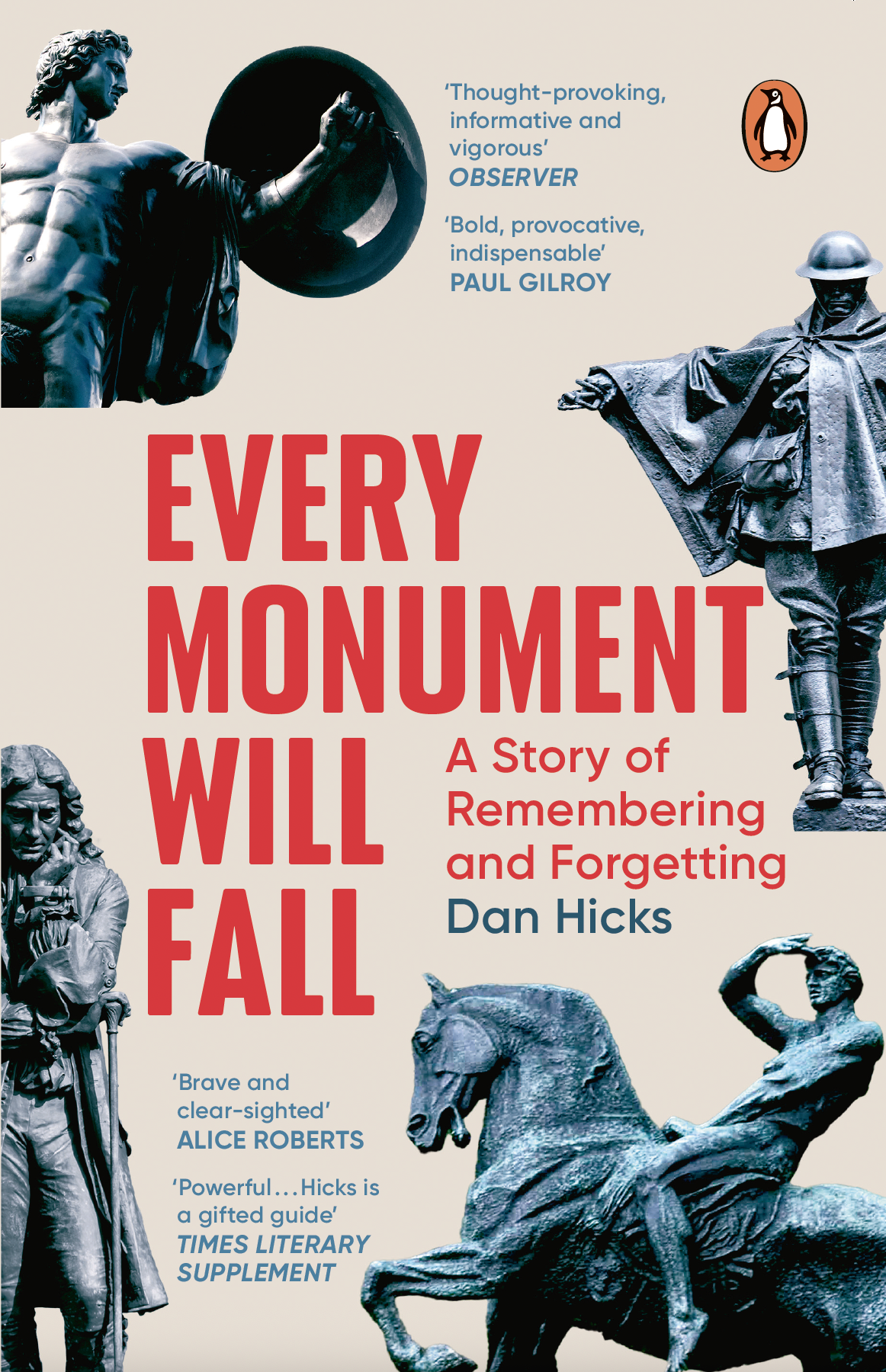
My book Every Monument Will Fall: a story of remembering and forgetting was published in May 2025, and was named one of Art Forum’s Best Books of 2025. The paperback is published in April 2026. The book compares the memorialisation of colonisers and enslavers in statues and monuments with the treatment of human remains in museums and universities. In doing so, it argues the case for the democratic right of societies and communities to re-shape their memory culture, defining who is remembered, and why, and how. You can read the preface to the paperback edition here.
Tracing the 19th-century origins of the very idea of ‘culture war’, the book joins the dots between the building of statues, the founding of disciplines like archaeology and anthropology, and the acquisition of stolen art and ancestral human remains. It introduces the idea of ‘Militarist Realism’ to describe a political, aesthetic, architectural and supremacist colonial movement across culture and the arts between the 1870s and the 1920s — a movement now re-emerging hand-in-hand with the revival of far-right imperialism in the USA and Europe in the 2020s.
Part history, part biography, part excavation, Every Monument Will Fall considers memorialisations of men like Cecil Rhodes and General Augustus Pitt-Rivers alongside the warehousing of human skulls in museums and universities. It tries to read the gaps and listen to the silences through the writing of Sylvia Wynter, Stuart Hall, Maggie Nelson, Saidiya Hartman, Michel-Rolph Trouillot, Aimé Césaire and Ursula Le Guin. Drawing together forgotten pasts and open secrets about dehumanisation and the redaction of public memory, what emerges is a speculative history of inheritance, loss, collective mourning, and the possibility of a reconciliation that has not yet begun. This is a story about who gets named and who doesn’t, who is remembered and who is forgotten; who has been treated as human and who has not.
Refusing to choose between pulling down every single statue, or holding onto every last vestige of a past that future generations could never change, Every Monument Will Fallmakes the case for allowing monuments of all kinds to fall once in a while. The result is an urgent appeal to reassemble the fragments, listen to the silences, value life and humanity above material things – and to rebuild a new kind of memory culture.
The publication of the book was reported as an exclusive by The Guardian, with news reports following up in The Times, The Independent, VICE, Der Spiegel (Germany), El País (Spain), Le Figaro (France), BNNVara (the Netherlands), Política(Greece), Globo (Brazil), UNN (Ukraine) and many other news channels, newspapers and media. There was also a strange op-ed by Dominic Sandbrook in The Times a reply to which was published on the letters page of The Times.
You can order the book in hard copy, pdf or as an audio book (read by Dan himself) here >> https://www.penguin.co.uk/books/452252/every-monument-will-fall-by-hicks-dan/9781529152746
Reviews of Every Monument WIll Fall
-
"An extraordinary intervention. If you want to understand the stakes and the limitations of contemporary conflict over culture and colonial history this bold, provocative book is an indispensable resource"
— Paul Gilroy, Professor of the Humanities, UCL
-
"Hicks writes with grace and fierce focus about what we choose to remember and why, in our patterns of thought, our institutions and the built environment in which we live"
— Eyal Weizman, director of Forensic Architecture and Professor of Spatial and Visual Cultures, Goldsmiths University of London
-
"Hicks reflects on the colonial origins of British heritage, the politics of naming and un-naming, and why dismantling these inherited structures of power should not be seen in terms of 'destruction'."
Jacobin Magazine
-
"In this passionate and searing call for cleansing the hurtful and oppressive accretions of history that we call monuments, Hicks pulls no punches."
— Chika Okeke-Agulu in Art Forum
-
"Powerful… Hicks is a gifted guide."
— Times Literary Supplement
-
“A thought-provoking, informative and vigorous read”
— The Observer
-
"Urgent and insightful, Every Monument Will Fall challenges all our presumptions about global history by taking us on a radical tour through the colonial archive.”
— Dr Kojo Koram, author of Uncommon Wealth: Britain and the Aftermath of Empire
-
"Brave and clear-sighted. Hicks opens up an extraordinary conversation between the past and the present. This is a book about falling statues, but so much more. It’s about how we’ve been lied to, and how we can approach the past with honesty."
— Alice Roberts, Broadcaster and Professor at the University of Birmingham
-
‘An astonishing tour de force. Every Monument Will Fall brilliantly propels us through a history of the interlocking lives of the people—writers, soldiers, academics, white supremacists—who mired the discipline of anthropology in racial violence and imperial longing. In weaving together archival research, critical theory, and biographic narrative with the urgency of a polemicist and in stark metaphors of weaponry and warfare, Hicks restores voice and form to the human subjects who these anthropologists have tried their best to dehumanise and destroy. A powerful follow-up to The Brutish Museums, Every Monument Will Fall will inspire scholars, writers, artists, and activists to challenge the monumental institutions of modernity—the university, the museum, and history itself.’
— Isaac Julien, Distinguished Professor of the Arts, University of California Santa Cruz
-
“‘Every Monument Will Fall is a reckoning, or better phrased, a wrecking ball to the structural myths that uphold the museum and the monument in western democracies whose spoils are the result of pillage, colonialism, and captivity. A brilliant cross genre text, Every Monument Will Fall is at once rigorous art criticism, intellectual history, critical theory, and an epistolary addressed (in a project about redress and demolishment) to himself as the author, to a composite figure of the western human, to those absorbed into whiteness, to the subject of historical narrative, to the biographical figures who inaugurate the monuments and museums, and those who orchestrate their demise."
— Nicole Fleetwood, Paulette Goddard Endowed Professor of Media, Culture, and Communication at NYU and author of Marking Time: Art in the Age of Mass Incarceration
